Why Better Balance Matters As You Age: 5 Enjoyable Ways To Stay Strong
"But as you age, your balance tends to become less dependable, especially if you don't engage in regular coordination exercises.” Dr Daniel Amen, neuroscientist, psychiatrist and author of Memory Rescue
A split second is all it takes. You catch your foot on an uneven pavement, stumble over a tree root or lose your footing as you step off a curb. Before you've had time to think about what's happening, your brain and body are already working together to keep you upright.
Your eyes register what's around you. Your inner ear detects the change in position. Your muscles respond, making rapid adjustments to help you regain your balance.
It's an extraordinary process that happens almost automatically, hundreds of times throughout the day. Yet balance is one of the most overlooked aspects of healthy ageing.
Good balance helps us remain active, maintain our strength, reduce our risk of injury and continue enjoying the activities that make life worthwhile.
And because staying physically active is so important for brain health, looking after our balance can have benefits that extend well beyond our ability to stay upright.
The encouraging news is that balance is a skill we can continue to develop as we age. And some of the most effective ways to challenge it are also among the most enjoyable.
Your brain is working harder than you think
Balance isn't simply a matter of having strong legs. Every time you walk, turn, bend down or reach for something, your brain is processing a constant stream of information from different parts of your body.
Several systems work together to make this possible:
Your eyes help you judge distances, identify obstacles and understand where you are in relation to your surroundings.
Your inner ear contains the vestibular system, which detects movement and changes in head position.
Your muscles and joints provide information about where your body is in space. This is known as proprioception.
Your brain, particularly the cerebellum, integrates this information and helps coordinate the muscular responses needed to maintain stability.
All of this happens remarkably quickly, usually without any conscious effort.
But as we get older, changes in vision, muscle strength, sensation and the vestibular system can make balancing more challenging. Certain medications and health conditions can also affect stability.
But when we practise balancing, learn new movement patterns or challenge our coordination, we give our brain opportunities to develop how it performs those tasks.
This means that we can improve our ability to coordinate our movements as we age. And that's worth taking advantage of!
Three reasons better balance matters for brain health
1. Better balance helps you stay active
One of the less obvious consequences of declining balance is that it can gradually change how much we move. Someone who feels unsteady might begin avoiding longer walks, unfamiliar places or activities involving quick changes of direction.
Initially, these decisions may seem insignificant. But over time, reduced activity can affect cardiovascular fitness, muscle strength and confidence. And that's important for our brains.
Our brains require a continuous supply of oxygen and nutrients delivered through the bloodstream. Regular physical activity supports cardiovascular health and the blood vessels that help maintain this supply.
Exercise is also associated with better cognitive function and a lower risk of cognitive decline. In other words, the more confident and capable we feel when moving, the easier it becomes to maintain the active lifestyle that supports a healthy brain.
2. Better balance helps you maintain muscle mass and manage your weight
From midlife onwards, we can gradually lose muscle mass and strength, particularly if we become less physically active. This can affect much more than our ability to lift heavy objects.
Strong muscles help stabilise our joints, support our posture, maintain our balance and make everyday activities easier. They also play an important role in metabolic health.
Skeletal muscle is a major site for glucose uptake, helping our bodies regulate blood sugar levels. Maintaining muscle through regular activity and resistance exercise can therefore support healthy insulin sensitivity.
When poor balance leads to reduced activity, it may become harder to maintain muscle and manage our weight.
Of course, balance exercises alone aren't a weight-management strategy. But better stability can make it easier to keep walking, exercising and participating in activities that help us maintain a healthy body composition.
Balance, strength and metabolic health are closely connected. Looking after one can make it easier to look after the others.
3. Better balance can help prevent head injuries
Falls are a significant health concern as we get older. According to the NHS, around one in three adults aged 65 and over, and around half of people aged 80 and over, experience at least one fall each year.
Some falls result in little more than a bruise. Others can cause fractures, hospital admissions or serious head injuries.
A blow to the head can cause a concussion or a more severe traumatic brain injury (TBI), potentially affecting memory, concentration, mood and everyday functioning.
Research has also identified an association between traumatic brain injury and increased dementia risk, although this doesn't mean everyone who experiences a head injury will develop dementia. The risk depends on factors including the nature and severity of the injury.
Preventing falls is therefore an important part of protecting both our physical independence and long-term brain health. And there's good evidence that we can make a difference.
Research shows that appropriately designed exercise programmes, particularly those involving balance and functional movements, can reduce falls among older adults living independently.
Rather than allowing concerns about falling to make us less active, we can take practical steps to become stronger and steadier.
4 Enjoyable ways to improve your balance, strength and coordination
The good news is that improving balance doesn't have to involve complicated equipment or hours in the gym. In fact, variety can be particularly useful because different activities challenge our balance systems in different ways.
Here are five ways to get started.
1. Practice three simple exercises at home
Sometimes the simplest exercises are the easiest to build into everyday life. These three movements can help develop leg strength, stability and coordination.
Stand on one leg. Stand beside a sturdy kitchen worktop or chair that won't move. Lift one foot slightly off the floor and aim to balance for 10 seconds. Repeat on the other side. Use support whenever you need it.
Sit to stand. Sit upright on a sturdy chair with your feet flat on the floor. Stand up, then lower yourself back down with control. Aim for 5–10 repetitions, using your hands for assistance if necessary. This strengthens the muscles you rely on when getting out of chairs, climbing stairs and walking.
Walk heel to toe. Position yourself alongside a wall or worktop. Take 5–10 slow steps, placing the heel of one foot directly in front of the toes of the other, as though walking along a straight line. Keep support within reach.
These exercises are particularly useful because they practise movements relevant to everyday life.
You could stand on one leg while waiting for the kettle to boil, practise sitting and standing during a television break or spend a couple of minutes working on your balance before a walk.
Small amounts of regular practice can add up.
2. Try a racket sport
Badminton and table tennis aren't just enjoyable ways to get moving. They also require your brain and body to work together continuously. Think about everything happening during a rally.
Your eyes track the ball or shuttlecock. Your brain judges its speed and direction. Your feet reposition your body while your muscles make rapid adjustments to help you stay balanced.
These activities challenge:
Hand-eye coordination.
Reaction time and attention.
Sideways movement and footwork.
Balance during changes of direction.
Cardiovascular fitness and muscular endurance.
If you haven't played a racket sport for some time, start at a comfortable pace, warm up properly and build your confidence gradually.
The combination of movement, coordination, concentration and social interaction makes racket sports an appealing option for people who enjoy a little friendly competition.
3. Get dancing
Dancing is one of those activities that offers far more than meets the eye. Whether you prefer ballroom, line dancing, salsa or something more contemporary, dancing challenges your brain and body simultaneously.
You need to coordinate your movements with music, remember sequences, shift your weight and sometimes change direction quickly. All of this requires communication between your brain, nervous system and muscles.
Depending on the style, dancing can help improve balance, lower-body strength, mobility and coordination.
There's also a cognitive element. Learning a new routine requires attention and memory, while responding to rhythm and a partner's movements adds another layer of mental engagement.
Research suggests that dance-based programmes can improve several aspects of physical function, including balance, in older adults. And let's not overlook the enjoyment and social connection that often come with it.
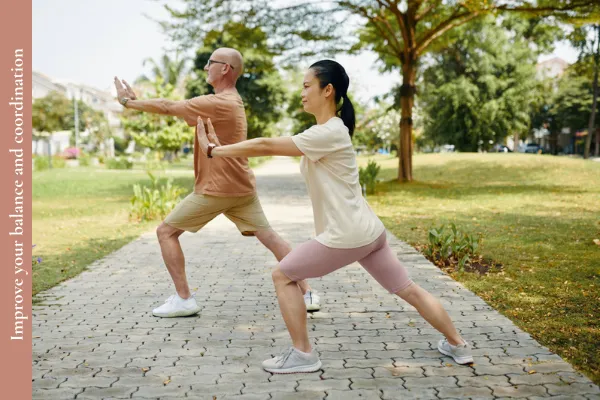
4. Explore Tai Chi or yoga
If you prefer activities involving slower, more controlled movements, Tai Chi is particularly worth considering.
Originating in China, Tai Chi involves flowing sequences of movement, controlled shifts in body weight and attention to posture. Although the movements may look relatively simple, they challenge the body to maintain stability while moving between different positions.
Tai Chi can help develop:
Balance and coordination.
Lower-body strength.
Body awareness.
Controlled movement and mobility.
Importantly, Tai Chi has a strong evidence base for reducing falls in older adults living in the community.
A major Cochrane review found that exercise programmes focused on balance and functional movements reduce the rate of falls, with Tai Chi also showing benefits.
Yoga can offer similar opportunities to develop body awareness, strength and flexibility, particularly when sessions include appropriate standing balance exercises. However, the evidence for yoga specifically preventing falls is less established than it is for Tai Chi.
Look for a beginner-friendly class suited to your current abilities, and don't hesitate to use support or adapt movements when needed.
5. Walk on varied terrain
Walking is one of the most accessible ways to support cardiovascular fitness, mood and brain health. But where we walk can make a difference to how our bodies are challenged.
A treadmill or smooth pavement provides a relatively predictable surface, whereas a woodland path, grassy field, coastal trail or stretch of sand requires our bodies to make more frequent adjustments.
Every small change in the ground beneath our feet provides new sensory information. Our ankles, legs and trunk muscles respond to help maintain stability, while our brains continually adjust our movements to the changing terrain.
Walking on varied surfaces can therefore provide a useful opportunity to practise adapting to the environment. However, it's worth distinguishing between challenging your balance and taking unnecessary risks.
Start with a familiar grassy area or a well-maintained woodland path, then gradually explore more varied terrain as your confidence and ability improve. Wear footwear with good grip, pay attention to conditions underfoot and choose routes suited to your current mobility.
The aim is to develop your ability to respond confidently to different surfaces while enjoying being outdoors.
The secret is to keep challenging yourself
There's an important principle behind all five activities: our bodies adapt to what we regularly ask them to do.
If we only ever move in familiar ways, we miss opportunities to develop the strength, coordination and stability needed for more demanding activities. But when we introduce manageable challenges, we give our muscles and nervous system opportunities to adapt.
That might mean gradually increasing how long you can stand on one leg, joining a beginner's dance class, returning to a racket sport or exploring a new walking route.
The key is to make the challenge appropriate for your current abilities and increase it progressively.
UK physical activity guidance recommends that older adults include activities that improve strength, balance and flexibility on at least two days each week, alongside regular aerobic activity.
If you're already active, consider whether your usual routine includes enough variety.
Walking is excellent exercise, but it doesn't necessarily challenge balance in the same ways as Tai Chi, dancing or movements involving changes of direction. Similarly, strength training is valuable, but it doesn't automatically replace practising balance itself.
A combination of activities can help develop the different physical abilities we rely on in everyday life.
If you've experienced repeated falls, significant unsteadiness or unexplained dizziness, speak to your GP or a physiotherapist before attempting more demanding balance activities. They can help identify any underlying causes and recommend appropriate exercises.
Better balance means more freedom
One of the things I find most encouraging about healthy ageing is how much we can influence through the choices we make today. We can't prevent every age-related change, but we can take practical steps to maintain our strength, mobility and confidence.
And balance is a wonderful example.
It's about much more than avoiding a fall —important though that is. It's about being able to walk through the countryside, explore somewhere new, enjoy a game of table bennis, dance at a celebration or get down on the floor with your grandchildren — and feel confident doing it.
It's also about maintaining the freedom to stay physically active, which is so important for protecting our brain health as we get older.
You don't need to become an expert at Tai Chi, master a complicated dance routine or start playing competitive sport. Choose something you enjoy. Start where you're at. Give yourself a little challenge and build on it consistently.
Because investing in your balance today is an investment in your strength, independence and the freedom to keep enjoying life for years to come.
References and further reading
1. UK Chief Medical Officers' Physical Activity Guidelines (2026). Updated guidance on strength, balance, flexibility and aerobic activity, including the importance of physical activity for cognitive health. Read the UK guidelines.
2. Sherrington C. et al. (2019). Exercise for preventing falls in older people living in the community. Cochrane Database of Systematic Reviews. This review found that exercise programmes reduced the rate of falls by approximately 23%, with particularly good evidence for balance and functional exercises. Read the Cochrane review.
3. Lu et al. (2024). The effects of dance interventions on physical function and quality of life among middle-aged and older adults. A systematic review reporting improvements in balance, postural control and physical function. Read the research.
4. Zhang H. et al. (2025). Effects of dance interventions on cognitive function, balance, mobility, and life quality in older adults. A systematic review and network meta-analysis examining the benefits of different dance styles. Read the research.
5. NHS: Physical activity guidelines for older adults. Practical recommendations for incorporating strength, balance and flexibility exercises into everyday life. Read the NHS guidance.