Finding Meaning And Purpose In The Second Half Of Life
"Believing your life matters is essential to happiness. When you know your purpose, you feel more significant, happier, and more connected." Dr Daniel Amen, psychiatrist, founder of Amen Clinics and author of You, Happier
What gets you out of bed in the morning?
It sounds like a simple question. But our answer may matter more than we realise.
For much of our adult lives, purpose is often provided for us. There are qualifications to gain, careers to build, bills and mortgages to pay, children to raise and people who depend on us. There is usually something that needs doing and somewhere we need to be.
Then we reach our 50s and 60s, and life begins to change.
Children may need us differently. We may be approaching retirement or reconsidering what we want from our working lives. Parents may need more of our time and support. We may have experienced loss or changes in our health. And perhaps for the first time in decades, we find ourselves thinking seriously about what we want the next chapter of our lives to look like.
That makes midlife an ideal time to ask a different question:
When you no longer have to live quite so much according to everyone else's agenda, what do you want to get up in the morning for?
It turns out that having an answer may be good for our health as well as our happiness.
What the world's longest-lived people can teach us
You may have heard of the Blue Zones: communities around the world that have become known for the longevity of their inhabitants.
One of the characteristics identified by the Blue Zones research is having a sense of purpose.
In Okinawa, Japan, there is the concept of ikigai. In Nicoya, Costa Rica, there is plan de vida. Blue Zones describes both in beautifully straightforward terms: "why I wake up in the morning."
In Nicoya, for example, older people often retain a strong sense of being needed and of contributing to something larger than themselves. Blue Zones goes as far as suggesting that knowing your sense of purpose could be worth up to seven years of additional life expectancy.
We need to be careful with that figure. It doesn't mean that discovering your purpose on Monday automatically adds seven years to your life. Longevity is influenced by many different factors.
But there is growing scientific evidence that a strong sense of purpose is associated with better health and longevity.
And perhaps the more interesting question isn't simply whether purpose can add years to our lives.
Could it also add more life to our years?
Why purpose matters for our health
One fascinating study published in JAMA Network Open followed 6,985 American adults over the age of 50.
Researchers measured participants' sense of purpose and followed them over several years. Those with the lowest levels of purpose had a significantly higher risk of dying during the follow-up period than those reporting the greatest sense of purpose. The association remained even after researchers accounted for factors including age, physical activity, smoking, chronic illness, depression, anxiety, optimism and social participation.
That doesn't prove that purpose itself causes us to live longer. People who are healthier may find it easier to live purposeful lives, and many different factors are involved.
Nevertheless, the association is compelling.
One reason may be that having something to live for influences how we live today.
If you want to be fit enough to explore new places, watch your grandchildren grow up, continue contributing through your work, support someone you care about, tend your allotment, serve your community or pursue something you've always wanted to learn, looking after yourself has a reason behind it.
Purpose can give us direction. Instead of simply trying to avoid disease or decline, there is something we're moving towards.
It can give us resilience. Difficult circumstances don't disappear, but knowing what matters to us can help us keep moving through challenging seasons.
It often gives us connection. Many of the things that give our lives meaning involve other people - family, friends, colleagues, volunteering, mentoring, faith, community or service.
And importantly, it can give us motivation.
There is a big difference between thinking, I really ought to look after myself as I get older, and thinking, I want to look after myself because there are things I still want to do and people I want to be there for.
Purpose may matter for your brain, too
The potential benefits aren't limited to physical health.
Researchers are increasingly interested in the relationship between purpose and cognitive health.
A large study using data from the US Health and Retirement Study looked at 13,689 people who had normal cognitive function at the beginning of the study. Participants were followed over many years, with researchers assessing areas including memory, attention, working memory and processing speed.
Greater purpose in life was associated with a lower risk of developing cognitive impairment and with cognitive impairment occurring later. Importantly for those of us thinking about prevention in midlife, the researchers specifically investigated whether this association could be seen as early as our 50s and 60s.
Again, this doesn't mean that having a purpose will prevent dementia. Cognitive health is far more complex than that.
But it does add another interesting piece to the healthy-ageing puzzle.
Our brains thrive on engagement. Staying curious, learning, connecting with other people and having meaningful reasons to participate in life all give our brains something to do. This fits closely with what we already know about keeping the ageing brain active, curious and socially connected.
Your purpose doesn't have to change the world
There's one problem with talking about "finding your purpose."
It can sound enormous.
We can imagine that we need to start a charity, write a book, change career, launch a business or identify the great mission we were put on Earth to accomplish.
Purpose doesn't have to look like that.
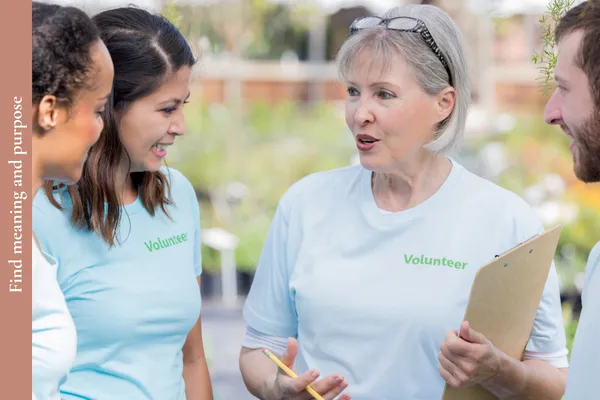
It could be helping with your grandchildren. Supporting an ageing relative. Being the friend who brings people together. Growing vegetables. Coaching a local sports team. Serving in your church or community. Mentoring someone younger. Learning a skill and sharing what you've learned. Creating something. Caring for animals. Supporting a cause. Becoming a better partner or friend.
It can also be more than one thing.
And importantly, our purpose can change as our lives change.
What gave your life direction at 35 doesn't necessarily have to be what gives it direction at 65.
There may even be seasons when our purpose becomes much smaller and more immediate. Caring for someone we love, recovering from illness or supporting our family through a difficult period can temporarily reshape what matters most.
We don't have to manufacture a grand mission statement.
We can simply start paying attention to what makes life feel worthwhile.
Six questions to help you rediscover what matters
If you're not immediately sure what your sense of purpose is, don't worry about finding the perfect answer.
Instead, get curious.
Find ten quiet minutes, grab a notebook and consider these questions:
What do I love to do?
Who do I do it for?
Are there hurts from my past that I can turn into help for others?
What do others want or need from me?
How do others change as a result of what I do?
How do I want to be remembered?
Don't edit your answers or worry about whether they're impressive enough.
You're looking for clues.
Look for the clues already in your life
We sometimes assume purpose is something we need to go away and find. Often, parts of it are already there.
Think back over the last few weeks.
When did you lose track of time because you were absorbed in something?
Which conversations left you feeling energised?
When did you feel particularly useful?
What did you look forward to?
Who did you enjoy helping?
What have you been curious about?
When did you think, "I'd like to do more of that"?
Those moments are worth noticing.
Perhaps you've always loved helping younger colleagues develop their confidence. Maybe you're at your happiest outdoors. Perhaps you come alive when you're learning, making, fixing, teaching, cooking, organising, creating or bringing people together.
You don't necessarily have to invent your purpose.
Sometimes you simply have to notice the breadcrumbs that have been there all along.
Your next chapter still matters
We talk a great deal about the physical habits that can help us age well.
Eat nutritious food. Stay active. Get enough sleep. Look after your blood pressure. Keep your brain stimulated. Maintain strong relationships.
All of those things matter.
But perhaps we need to make room for another part of healthy ageing too.
What are we staying healthy for?
Our 50s and 60s don't have to be a period in which we simply try to preserve what we've already got.
These can be years when we reassess what matters. When we use the experience we've accumulated. When we let go of things that no longer deserve so much of our time. When we discover new interests, deepen relationships and decide more deliberately what we want the next chapter to contain.
We may not be able to control how long that chapter will be. But we can have considerable influence over how we fill its pages.
We spend a lot of time talking about the habits that may help us live longer.
Perhaps we should also ask what makes the life we're protecting worth living.
References
Alimujiang A, Wiensch A, Boss J, et al. Association Between Life Purpose and Mortality Among US Adults Older Than 50 Years. https://jamanetwork.com/journals/jamanetworkopen/fullarticle/2734064
Howard, N.C., Gerasimov, E.S., Wingo, T.S. and Wingo, A.P. (2024), Purpose-in-life associates with later onset and lower hazard for cognitive impairment in a population-based, longitudinal cohort of diverse participants. Alzheimer's Dement., 20: e088289. https://doi.org/10.1002/alz.088289