5 Ways Family And Friends Can Support Your Health Goals In Midlife
"Diet and nutrition books can give you the nuts and bolts, but only the mutual support of others can increase your results and sustain them.” Dr Daniel Amen, neuroscientist, psychiatrist and co-author of The Daniel Plan: 40 Days to a Healthier Life
Have you ever started making positive changes to your health, only to find that the people around you aren't quite as enthusiastic as you are?
Perhaps you've decided to eat more healthily, exercise regularly or improve your sleep. You're feeling motivated, you've made a promising start, and you're determined that this time your new habits will stick.
Then someone offers you a slice of cake, suggests skipping your walk because the weather isn't great, or encourages you to stay up late watching another episode of your favourite television programme.
You might hear comments like:
"Oh, go on! One more won't hurt."
"You can always start again on Monday."
"You're healthy enough already. Why bother?"
"Surely you can miss your exercise just this once?"
Usually, these comments come from people who care about us and mean well. But when they happen regularly, they can make it surprisingly difficult to follow through with our intentions.
The truth is, the people we spend time with can have a powerful influence on our health habits, for better or worse.
And if we want to stay active, healthy and mentally sharp as we age, learning to enlist the support of others could make a significant difference.
Why the people around us influence our habits
We often think that improving our health is simply a matter of making better decisions and having enough willpower to stick with them. But behavioural science tells us that our environment, including the people around us, plays an important role in shaping our choices.
We're social beings. We naturally take cues from others about what's normal, acceptable and enjoyable.
If your friends regularly meet for walks, being physically active can become a natural part of your social life. If everyone around you tends to spend their evenings watching television and snacking, making different choices may require more conscious effort.
Research has also found that social support can help people adopt and maintain healthier behaviours, particularly when that support is practical, encouraging and suited to their individual needs.
There are several reasons for this.
Firstly, we tend to follow social norms. When healthy behaviours are common among the people we spend time with, they're more likely to feel normal and achievable.
Secondly, accountability can help us follow through. Knowing that someone is expecting us to turn up for a walk or will ask how we're getting on can provide an extra incentive, especially when our initial enthusiasm fades.
Thirdly, encouragement reinforces our progress. When someone notices our efforts and celebrates our achievements, it can strengthen our confidence and motivation to continue.
And there's another important benefit, particularly in midlife.
Meaningful social connections are associated with better emotional wellbeing and cognitive health as we age. So when we combine healthy activities with opportunities to connect with others, we're potentially supporting our brain health in more ways than one.
Supporters or accomplices? Learning to recognise the difference
Here's something worth considering: Are the people closest to you helping you become the person you want to be, or are they unintentionally encouraging you to abandon your intentions?
I like to think of the difference between supporters and accomplices.
A supporter is someone who respects what matters to you and encourages you to follow through, even when doing so requires effort.
An accomplice, in this context, is someone who helps you justify abandoning your intentions, perhaps because they enjoy your company, prefer things as they are or simply don't understand why you're making changes.
For example, imagine you've decided to improve your fitness by walking regularly.
A supporter might say, "It's looking a bit cloudy, but shall we put our coats on and go anyway?"
An accomplice might say, "It's miserable outside. Let's have a coffee instead."
Or perhaps you're working towards improving your eating habits.
A supporter might say, "I know you're trying to eat more healthily. What would you enjoy?"
An accomplice might say, "Oh, don't be boring! Have another helping. You can get back on track tomorrow."
Of course, there's nothing wrong with occasionally enjoying a slice of cake, taking a rest day or changing your plans. Flexibility and enjoyment are important parts of a healthy lifestyle too.
And someone who encourages you to do these things isn't necessarily undermining your progress.
What matters is the pattern of influence. Does spending time with this person generally make it easier or harder to follow through with what you've decided is important?
It's also worth remembering that someone can be a wonderful friend or loving family member without sharing your enthusiasm for healthy living. They don't have to adopt your habits to respect your choices.
Take a moment to think about the people you spend the most time with.
Who encourages you to follow through with your intentions? Who celebrates your achievements? And whose influence sometimes makes it harder to stay on track?
Recognising the difference can help you make more intentional choices about the support you seek.
5 Ways to enlist the support of family and friends
You don't have to rely entirely on your own motivation to build healthier habits. There are practical ways to involve others that can make the journey more enjoyable and sustainable.
1. Share your intentions with people who will encourage you
One of the simplest things you can do is tell someone you trust what you're working towards. But rather than simply announcing that you're going to lose weight, exercise more or eat better, explain why it matters to you.
Perhaps you want to improve your strength and mobility so you can continue enjoying walking holidays. Maybe you'd like more energy to spend time with your grandchildren, or you want to protect your memory and independence as you get older.
When people understand the reasons behind your intentions, they're often better equipped to support you.
I experienced this myself when I decided to lose weight several years ago. My husband was incredibly supportive. He exercised with me and didn't continually put temptation in my way, which made it much easier to stay consistent.
That support made a real difference, and I went on to lose 28 pounds, which I've successfully kept off for more than a decade.
Try this: Choose one person who you know will encourage you and explain what you're working towards. Then ask for something specific, such as, "I'm trying to walk after dinner four evenings a week. Would you help me protect that time?"
People are often happy to help when they know exactly what would make a difference.
2. Share your successes with people who will celebrate them
When we're working towards improving our health, it's easy to focus on how far we still have to go rather than recognising how much progress we've already made. But acknowledging our achievements is an important part of building lasting habits.
Positive feedback can reinforce behaviours and strengthen our belief that we're capable of making changes. And the achievements don't have to be dramatic.
Perhaps you've completed three strength-training sessions this week, gone to bed earlier for several evenings or noticed that you're feeling more energetic in the afternoons.
These are all worth celebrating!
When you share your progress with someone who genuinely wants you to succeed, their encouragement can help reinforce your motivation.
Try this: Identify a friend or family member who will be pleased to hear about your progress. Make a point of sharing your small wins, perhaps during a weekly phone call or over coffee.
Remember, consistency and progress are more important than perfection. Celebrate the effort you're putting in, not just the results you're achieving.
3. Have someone you can call when your motivation dips
However committed you are to improving your health, there will inevitably be days when your motivation isn't quite what it was.
Perhaps you're tired, discouraged or frustrated because you're not seeing results as quickly as you'd hoped. Or maybe life has become particularly busy, and abandoning your new habits feels like the easiest option.
This is when having someone you can turn to can be invaluable.
Rather than waiting until you're ready to give up, identify someone in advance who can help you regain perspective.
It might be a friend who understands your goals, a family member who knows how important your health is to you, or a coach who can help you work through obstacles.
The most helpful person isn't necessarily someone who will tell you to push harder. It's someone who will listen, remind you why you started and help you decide on a realistic next step.
Sometimes we genuinely need to rest or adapt our plans. At other times, we simply need encouragement to keep going.
Try this: Ask someone you trust, "If I'm feeling discouraged or tempted to give up, would you mind helping me remember why I started?"
A five-minute conversation at the right moment could make all the difference.
4. Find someone to be active with
Exercise is one of the most powerful lifestyle habits we can adopt to support our physical and brain health as we age. Regular physical activity helps maintain muscle strength, mobility, cardiovascular health and cognitive function.
But knowing that exercise is good for us doesn't always make it easy to fit into our lives! Having someone to exercise with can make physical activity more enjoyable and give us an extra reason to turn up.
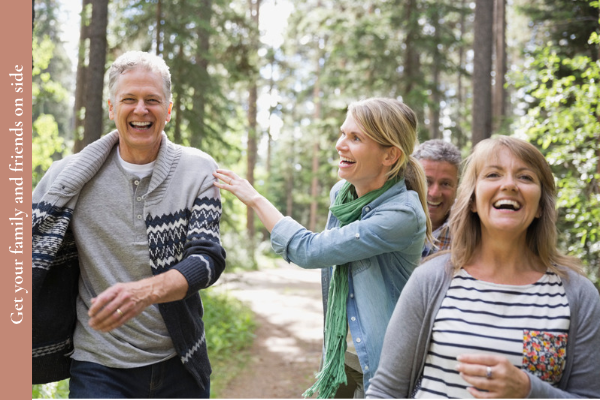
It might be a friend who joins you for a morning walk, a neighbour who enjoys swimming or someone who attends a weekly fitness class with you. You could even arrange walking meetings instead of always catching up over coffee.
Research suggests that social support can encourage physical activity, although the benefits depend on the type of support and the individuals involved.
And there's a wonderful additional benefit: you're nurturing your relationships at the same time as looking after your health.
Try this: Think of one person who might enjoy being active with you. Invite them to join you for a regular activity over the next four weeks.
Choose something you both enjoy. The aim isn't to create another demanding commitment but to make being active a natural and enjoyable part of your lives.
5. Expand your circle to include people who share your values
What if the people closest to you simply aren't interested in healthy living? Perhaps your partner has no desire to exercise, your friends prefer sedentary activities or your family doesn't understand why you're making changes.
That doesn't mean you need to abandon those relationships or persuade everyone to adopt your lifestyle. Instead, consider developing additional friendships with people who share your interests and values.
You might join a local walking group, attend a fitness class, take up a new sport, volunteer or become part of a community focused on healthy ageing.
Spending time with people who enjoy looking after their health can help make those behaviours feel like a normal part of everyday life. It can also introduce you to new activities, fresh perspectives and opportunities to learn.
This is particularly valuable as we move through our 50s and 60s, when changes in work, retirement and family responsibilities can affect our social connections.
Try this: Identify one group, class or community where you could meet people who enjoy the activities you'd like to do more often. You might discover a new interest, develop some lasting friendships and find the encouragement you need to keep progressing.
And remember, you can also become that source of encouragement for someone else.
What if the people closest to you aren't supportive?
Sometimes, despite our best efforts, the people around us don't understand or support the changes we're trying to make. This can be particularly challenging when it involves a partner, close friend or family member.
If this happens, I'd encourage you to consider three things.
Explain your reasons without criticising their choices. Rather than telling someone they should be eating better or exercising more, focus on what matters to you. For example, "I've noticed I feel much better when I get enough sleep, so I'm making an effort to get to bed earlier."
Set respectful boundaries. It's perfectly reasonable to decline another drink, turn down an extra helping or protect time for exercise. You can do this without making anyone else feel judged.
Look for encouragement elsewhere. Your partner or closest friend doesn't have to provide every kind of support you need. You can maintain those important relationships while developing connections with people who share your health interests.
Ultimately, we each have responsibility for our own choices. But we can make those choices easier by being intentional about the influences around us.
Healthy ageing doesn't have to be a solo effort
Staying active, healthy and mentally sharp as we age isn't about making a handful of dramatic changes. It's about the small choices we make consistently over time.
And while those choices are ultimately ours to make, the people around us can have a significant influence on how easily we follow through.
Supportive relationships can provide encouragement when motivation dips, accountability when life gets busy and someone to celebrate with when we make progress. They can also make the journey towards better health more enjoyable.
We each have responsibility for our own health, but that doesn't mean we have to do everything by ourselves.
Sometimes one of the most powerful steps forward is inviting someone else to walk alongside us.